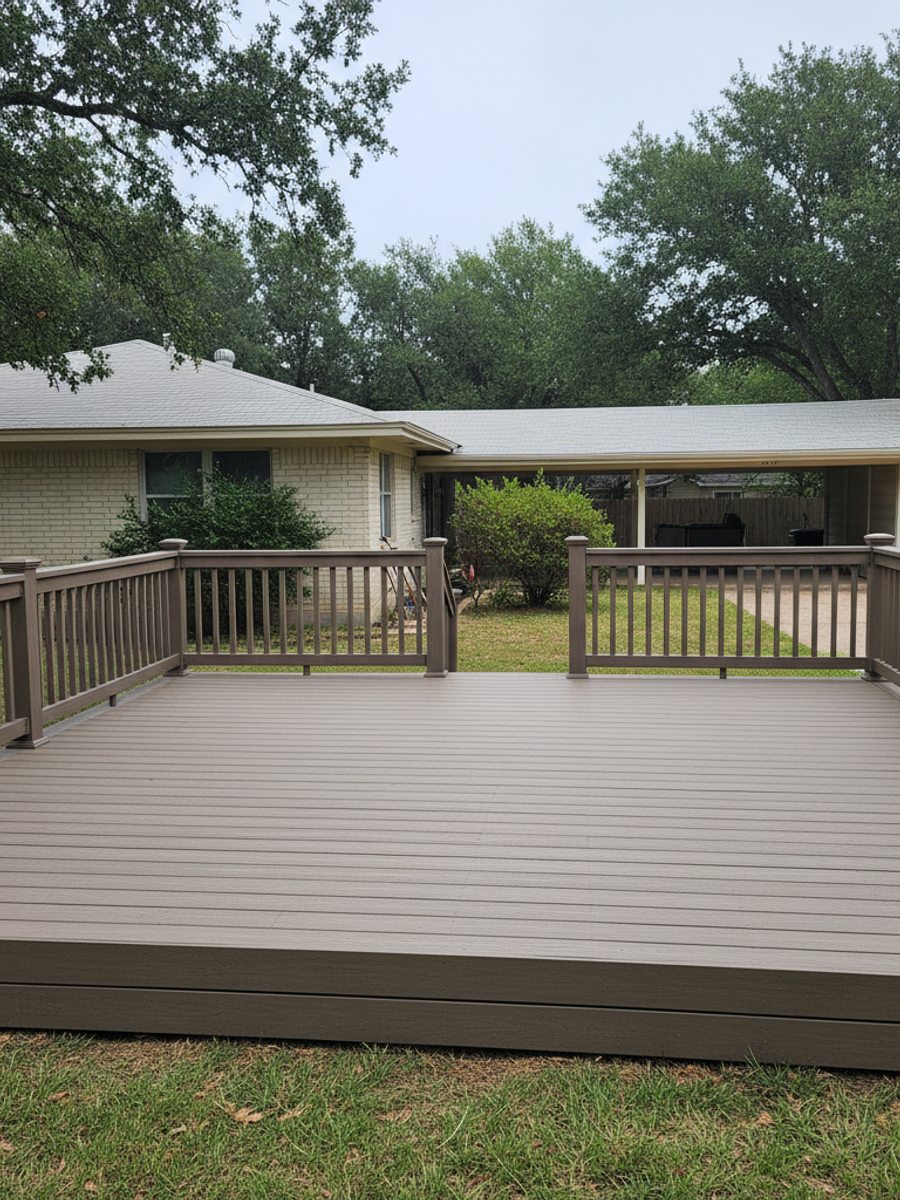
Anybody with a truck and a miter saw can call themselves a deck builder. The work that separates a deck that lasts fifteen years from one that starts wobbling by year three happens below the boards, where nobody looks. If you're hiring for the first time, here's what actually matters and what's just talk.
What the ground here does to a footing
Horizon City sits on desert soil with a caliche layer, usually a foot or two down, that's basically hardened calcium carbonate. It's not sand you can dig through with a shovel. A builder who's worked here knows that layer is coming and either breaks through it with an auger bit or a bar, or sets the footing on top of it if code and the engineering allow it. What you don't want is a crew that hits caliche, gets tired of fighting it, and sets a post on a patio block six inches down because it was easier. Footings for a deck post typically need to bear at a depth and diameter set by the local code official, often in the 24-inch range for a standard residential deck, and that number changes with post spacing and how much deck you're carrying. Ask what depth they're planning before they dig, not after.
The other thing caliche does is drain almost nothing. It's close to impermeable. So water that pools under a deck during a downpour doesn't soak in, it sits, and that matters more than people think when you're deciding where the ledger meets the house.
Heat, sun, and monsoon season
This part of Texas gets over 300 sunny days a year and summer surface temperatures on dark composite decking can climb past 150 degrees. That's not a defect, it's just what happens, but it means gapping between composite boards has to account for expansion, and it means a builder should be talking to you about board color and orientation, not just brand. Pressure-treated pine here dries out and checks faster than it would in a humid climate because the UV and low humidity pull moisture out of the wood. If nobody mentions sealing on a schedule of roughly once a year for a wood deck in full sun, they haven't dealt with what this sun does over time.
Then there's monsoon season, July through September, when this area can get an inch of rain in under an hour after weeks of nothing. Combine that with caliche's refusal to drain and you get water sheeting toward the house instead of away from it. The ledger board, the piece that bolts the deck to your house framing, is the single most common failure point on decks nationwide, and it's usually water intrusion behind flashing that was skipped or installed wrong. In a climate that goes from bone dry to a sudden downpour, that flashing detail matters more here, not less.
How permitting actually works
Horizon City, like most municipalities, requires a permit for a deck that's attached to the house or elevated above a certain height, and the inspection process usually happens in stages: footings get checked before they're backfilled, framing gets checked before decking goes down, and there's a final look at railings and stairs. Guardrails on a deck over 30 inches high need to be 36 inches tall with balusters spaced so a 4-inch sphere can't pass through, that's not a design choice, it's code. A legitimate builder pulls the permit themselves or walks you through exactly how you'll do it, and they don't flinch when an inspector shows up. If a contractor tells you permits are a waste of time or that they'll "handle it" without ever mentioning an inspection, that's worth asking more about. Plenty of the newer subdivisions here also have an HOA with its own approval process for anything visible from the street, so check that before material gets ordered, not after.
What's already in your yard
Homes in the older parts of the area and homes in newer subdivisions built in the last couple of decades have different problems. Older lots sometimes have utility lines, old irrigation, or a septic line that nobody marked clearly. Newer subdivisions tend to have decent grading from the builder but shallow soil over compacted fill, which changes how a footing performs. Either way, a call to 811 to mark utilities before digging isn't optional, and a builder who skips it to save a day is gambling with your gas line.
What to ask before you sign anything
- Are you licensed and insured, and can I see proof, not just hear you say it.
- Who's pulling the permit, and what inspections should I expect to see happen.
- What size and depth are the footings, and how are you handling the caliche if you hit it.
- How is the ledger board being attached and flashed.
- What's the payment schedule? A deposit is normal. Being asked for the full amount up front is not.
- Do you carry warranty on the labor separate from the manufacturer's warranty on the material.
Walk away if a bid is dramatically lower than everyone else's with no explanation, if nobody wants to talk about footing depth or flashing, or if the contract doesn't spell out materials by name and size, like "2x8 joists at 16 inches on center" instead of just "quality lumber." Vague contracts lead to vague decks.
None of this is complicated once you know what to listen for. Most homeowners just haven't had a reason to learn it before now. We've built and repaired decks all over this area long enough to know what the ground and the summer here do to a deck that wasn't built for it, and you can see more of that work at Omega Deck Co.